


















When you walk through the hallways of Englewood High School, you might notice something subtle but telling. Students moving from class to class, heads tilted downward, eyes locked onto glowing screens. Social media has become a constant presence in teenage life, shaping how students connect, relax, and even understand the world around them.
But what does that constant connection actually mean for teens?
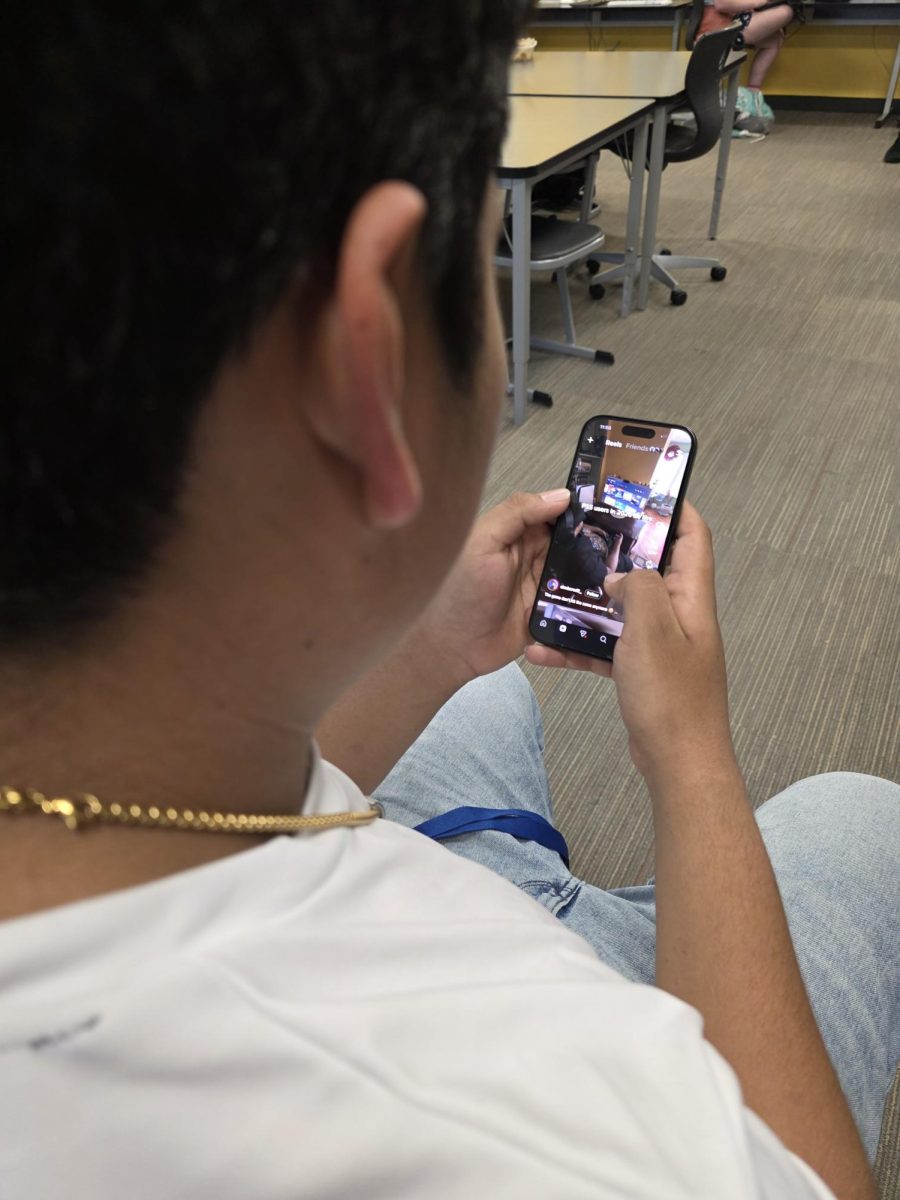
For many students, social media serves as a source of entertainment and escape. Junior Mateo Cruz says his time online is often spent exploring his interests.
“Usually when I scroll, I look at memes, Naruto images, cats, and other stuff like that.”
Yet not everything students encounter online is as harmless as it seems. Cruz recalls a moment that blurred the line between reality and artificial content.
“One time in chemistry last year, there was an AI video of two kids fighting, and they were Chinese babies, and we were confused as to whether they were AI or real. And everyone in our class thought that it was real or AI, and then it was eventually confirmed that it was AI.”
Experiences like this highlight a growing challenge for teens: distinguishing what’s real from what isn’t.
Sophomore Isaac Deherrera says social media can also bring a sense of pressure and uncertainty.
“Social media can be somewhat stressful, and I feel pressure because of the information circulating on it; I worry a great deal about that, as well as what is happening in the world around me.”
Because of this, Deherrera emphasizes the importance of being mindful while online.
“I feel that people should be careful: they shouldn’t overthink things or feel pressured by what is circulating in their environment; they should also dig a little deeper into the information to gain a better understanding of the situation as it unfolds.”
Deherrera suggests that, for those seeking information, the ideal approach is to verify the details of news stories before accepting them as factual.
National data reflects many of these student experiences. According to Pew Research, while most teens say social media helps them feel more connected to friends, about 1 in 5 also report that it negatively impacts their mental health. In 2024, 48% of teens said social media harms people their age, a notable increase from 32% in 2022. The research also found that parents tend to be more concerned about social media use than teens themselves.
At Englewood High School, media literacy is one way educators are helping students navigate this complex digital landscape. Teacher and media expert Karla Shotts believes students may be more prepared than many adults assume.
“I think our students know a lot more about AI and healthy habits online than their parents do, so the students know what to trust more than their adults. We spend a lot of time on media literacy in class.”
Shotts also acknowledges that social media is not going away—and that learning to use it responsibly is key.
“I actually think it has a lot of value, and it’s going to be here whether we want it to be or not, and teenagers are going to use it whether adults want them to or not.”
She says developing awareness and self-regulation will be critical skills for students moving forward.
“I think that is the most important skill to move forward with, so if they have an understanding of the issues associated with excessive screen time, they can regulate themselves. As a student, you can manage your own time and say, ‘Hey, I know for a fact that this is detrimental if I spend too much time on it. So, education for students and adults is always the best way to go.”
From entertainment to misinformation to mental health, social media continues to shape the high school experience. At Englewood, students are not just scrolling—they are learning how to question, evaluate, and navigate the digital world around them.